You’ve been thinking about a sleeve for a while now. Maybe you have a few scattered pieces already. Maybe you’re starting completely fresh. Either way, you want something that actually looks like it belongs on your arm — not a random collection of tattoos that happened to end up in the same place.
Designing a sleeve is one of the most exciting things you can do with your skin. It’s also one of the most involved. The difference between a sleeve that turns heads and one that just looks “busy” often comes down to planning. And that planning starts before you ever sit in the chair.
At Platinum Ink Tattoo & Body Piercing, we’ve been helping people in Austin bring large-scale custom work to life since 2002. This guide is everything we’d walk you through in a consultation — laid out so you can start thinking it through before you even book.
What Makes a Sleeve Different From Other Tattoos
A sleeve isn’t just a big tattoo. It’s a composition.
Think of it the way a painter thinks about a canvas — every element needs to relate to something else. When you treat a sleeve as one connected piece from the start (rather than filling space over time), the result looks intentional. Cohesive. Done.
The two most common mistakes people make:
- Adding pieces without a unifying theme or background
- Not thinking about how the design interacts with arm anatomy
We’ll cover both.
Start With a Clear Vision Before Your First Consultation
Before you sit down with an artist, it helps to have a general direction in mind. You don’t need to have every detail figured out — that’s what the collaboration is for — but walking in with a sense of the following will make your consultation far more productive.
Ask yourself:
- What style appeals to me? (Japanese Irezumi, American Traditional, black-and-grey, geometric, fine-line, realism)
- Color or black-and-grey?
- What’s the core subject matter? (Nature, architecture, portraits, abstract, personal symbols)
- Is there a story or meaning I want this to carry?
Artists consistently point out that meaning is what separates sleeves that age well from ones people regret. As Emmanuel Fortunato, a professional tattoo artist, put it:
“Own it with intention… change the flow, add texture, integrate meaning… Your story makes the tattoo timeless.”
— Emmanuel Fortunato, tattoo artist (via Allure, December 2025)
That’s the mindset worth bringing into every decision you make from here.
2026 Sleeve Trends Worth Knowing About
Trends come and go, but the best sleeves pull from styles that have staying power. Here’s what’s resonating in 2026, according to artist interviews and industry forecasts.
Black-and-Grey Abstracts
Ink splashes, brushstroke textures, and broken geometries are showing up everywhere on medium-to-large arm pieces. This style works especially well for full sleeves because it creates depth without relying on color that can fade unevenly.
Nostalgic and Personal Themes
Titanic “Heart of the Ocean” motifs, Lisa Frank-inspired vibrancy, cherries, bows, and 1990s-2000s throwbacks are making a strong comeback. These work because they carry personal meaning for people who grew up with them — and meaning, as we said, is what makes a sleeve last.
Geometric and Futuristic Elements
Fractals, circuit-board patterns, 3D dot-work shading, and sharp symmetry translate beautifully to full sleeves. The arm’s contours actually enhance geometric precision when it’s planned correctly.
Fine-Line Florals and Lacework
Art Nouveau influences, sacred geometry, and delicate florals with negative space provide natural movement on the arm. Artist Jojo Lu describes it well:
“Floral, geometric, and fine-line pieces… work beautifully on the arms… These areas provide natural flow and movement.”
— Jojo Lu, tattoo artist (via Allure, December 2025)
Quick note: Trends are a starting point, not a rulebook. The best sleeve is the one that means something to you — not whatever’s popular right now.
How Arm Anatomy Should Shape Your Design
This is the part most people overlook, and it’s arguably the most important technical element of sleeve design.
Your arm isn’t flat. It curves, flexes, and creases. A design that looks perfect on paper can distort badly if it doesn’t account for how your arm actually moves and sits.
Here’s how different areas behave:
| Area | Characteristics | Design Considerations |
| Outer Upper Arm | Minimal movement, high visibility | Best for bold focal points |
| Forearm | Flat, good precision area | Excellent for fine detail; protect with sunscreen long-term |
| Elbow | High crease, higher pain | Needs careful planning; more touch-up potential |
| Inner Arm | More sensitive, less visible | Works for softer or more personal elements |
| Deltoid (Shoulder) | Rounded, curved surface | Requires radial design thinking to avoid distortion |
The goal is to plan radially — meaning your design wraps around the arm’s contours rather than sitting on top of them. Backgrounds like smoke, flowing water, clouds, or geometric connectors are what allow individual elements to feel unified as your eye moves around the arm.
According to updated guidance from Hyperinkers’ sleeve placement resource (updated December 2025), treating the elbow with radial symmetry and placing focal points on the outer bicep and forearm are among the most reliable methods for a cohesive result.
The 6-Step Planning Process for a Custom Sleeve
Here’s how the whole process typically breaks down. This is roughly what we walk people through at Platinum Ink Tattoo & Body Piercing in Austin.
Step 1: Define Your Vision Choose a core theme, style, and color direction. Decide whether you want a full sleeve (shoulder to wrist), half sleeve (upper or lower arm), or quarter sleeve. Full sleeves often require 40+ hours of work.
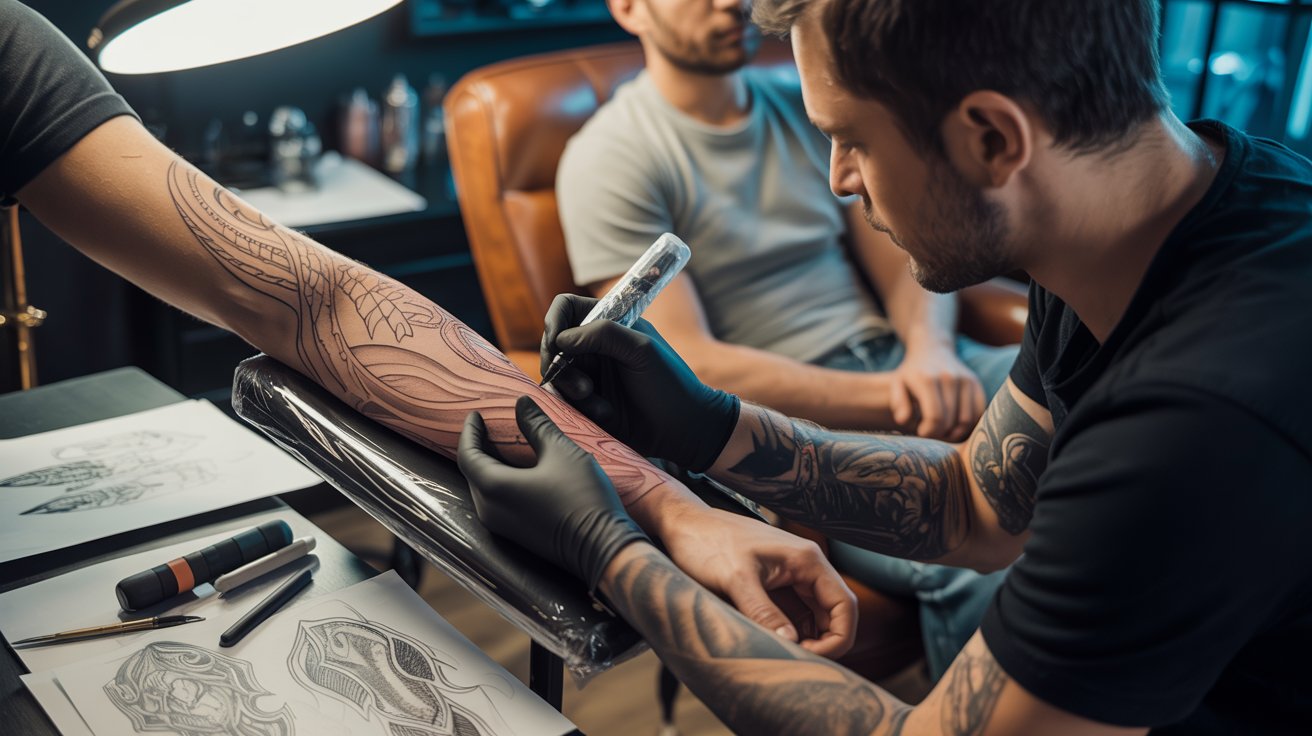
Step 2: Map Your Composition Sketch ideas or collect references. Plan where focal points live (outer bicep, forearm) and what will connect them. Decide on a background style that creates flow.
Step 3: Incorporate Personal Meaning Work with your artist early to weave in symbols, portraits, or narratives that matter to you. This is where the iterative back-and-forth pays off.
Step 4: Size and Proportion Scale everything to your specific arm shape. What works on a large forearm may look crowded on a narrower one. Your artist will refine this.
Step 5: Plan Your Sessions Most sleeves take 4 to 10+ sessions spread over months or even years. Plan for 2 to 3 weeks of healing between sessions — this isn’t optional, it’s what protects the quality of the work. Full sleeves are a long-term commitment.
Step 6: Collaborate Closely Bring references. Be open to refinements. A good artist won’t just tattoo your sketch — they’ll adapt it to your body for the best long-term result.
As Balam, a Texas-based artist at Symbiosis Tattoos, describes it:
“I enjoy the creative process of designing large compositions that flow with the body of the individual… Creating something that makes you feel in your greatest expression.”
— Balam, tattoo artist at Symbiosis Tattoos (via Allure, December 2025)
That collaborative relationship is what makes the difference between a sleeve that looks assembled and one that looks designed.
What to Bring to Your Consultation
Walking into a consultation prepared makes the whole process faster and more accurate.
Bring:
- Reference images (style, specific elements you love)
- Notes on meaning or personal story behind the sleeve
- Photos of any existing tattoos that need to be incorporated
- An open mind — your artist may have better ideas than your original sketch
Be ready to discuss:
- Your timeline and budget range (without committing to exact figures upfront)
- How often you’re able to book sessions
- Your lifestyle (sun exposure, job, etc.) since these affect longevity
Thinking about booking a consultation? Platinum Ink Tattoo & Body Piercing has been working with Austin clients on custom large-scale pieces since 2002. Reach out to our team to start the conversation.
Texas Regulations: What You Should Know
If you’re in Austin or anywhere in Texas, it’s worth knowing how the state regulates tattoo work — both for your safety and peace of mind.
Key points from Texas DSHS (Department of State Health Services):
- Tattoo studios (not individual artists) must hold a current DSHS license
- Studios are required to maintain clean facilities, use single-use or sterilized equipment, keep client records, and provide aftercare instructions
- All artists working in licensed studios are required to complete annual OSHA Bloodborne Pathogens training
- Minimum age for tattoos is 18
- Minors (under 18) may only receive tattoos for cover-ups of existing tattoos, with parental or guardian notarized consent — no exceptions for new designs
Austin and Travis County also enforce additional local health inspections and zoning compliance on top of state requirements. When choosing a studio, it’s worth confirming they hold a current DSHS license.
At Platinum Ink, we’ve maintained high hygiene and safety standards since we opened — it’s not just a legal requirement for us, it’s part of how we operate.
The Market Behind the Movement
Sleeves aren’t a niche request anymore. The tattoo industry as a whole reached USD 2.43 billion globally in 2025 and is projected to hit USD 2.66 billion in 2026, according to Fortune Business Insights. The sleeve segment specifically was valued at USD 0.6 billion in 2024, with a forecasted CAGR of 12% toward USD 1.5 billion in coming years.
In the US, approximately 21% of Americans have at least one tattoo (based on 2023 figures still cited in 2026 industry reports), and 38% of Millennials continue adding ink.
What this means practically: demand for skilled custom artists is high. Booking lead times at quality studios can be long. If you’re thinking about a sleeve, starting your consultation early — even before you’ve finalized your vision — is a smart move.
Ready to Start Your Sleeve?
A sleeve is a long-term project. The planning you do upfront directly affects how good it looks in 10 years — not just when it’s fresh.
If you’re in the Austin area and ready to start talking through ideas, Platinum Ink Tattoo & Body Piercing has the artists and experience to help you build something worth wearing for life. We’ve been part of the Austin tattoo community since 2002, and custom large-scale work is exactly what we’re here for.
Come in, tell us your idea, and let’s see what we can build.
Frequently Asked Questions
How do I start designing a tattoo sleeve? Start by choosing a style and theme that feels personal to you. Collect reference images, decide between color and black-and-grey, and think about what you want the sleeve to mean. Then book a consultation with a licensed artist who can translate that into a composition built for your specific arm.
How many sessions does a full sleeve tattoo take? Generally, a full sleeve requires anywhere from 4 to 10+ sessions depending on detail, size, and style. Sessions are typically spaced 2 to 3 weeks apart to allow for proper healing. Total timelines often run from several months to a few years.
How do I make sure my sleeve flows naturally? The key is treating the sleeve as one composition from the start — not a collection of separate pieces. Use transitional backgrounds (water, smoke, geometric connectors) to link elements, and plan focal points around your arm’s natural contours rather than flat sections.
What are the best themes for a full sleeve in 2026? Based on current artist forecasts, black-and-grey abstracts, nostalgic personal themes, geometric and futuristic patterns, and fine-line florals are among the most sought-after for full sleeves right now. The most enduring sleeves, though, tend to center on personal meaning over trend alone.
Can I get a sleeve tattoo if I already have existing tattoos on my arm? Yes. Existing tattoos can often be incorporated into a sleeve through consistent backgrounds, shared color palettes, or design elements that tie everything together. Discuss this with your artist early so they can plan around what’s already there.
What age do you have to be to get a tattoo in Texas? You must be 18 or older to get a tattoo in Texas. Minors may only receive tattoos in limited cover-up situations, with notarized parental or guardian consent, as outlined by Texas DSHS regulations.
How do I find a good tattoo artist for a sleeve in Austin? Look for a licensed studio with artists who have a strong portfolio in the style you want. Reviews, in-person consultations, and the cleanliness of the studio are all worth evaluating. Platinum Ink Tattoo & Body Piercing has been serving the Austin metro since 2002 and offers consultations for custom large-scale work.
Does arm placement affect how painful a sleeve tattoo is? Yes. Pain levels vary by area. The inner arm, elbow ditch, and wrist tend to be more sensitive. The outer upper arm and forearm are generally more tolerable. Your artist can walk you through what to expect for your specific design and placement.